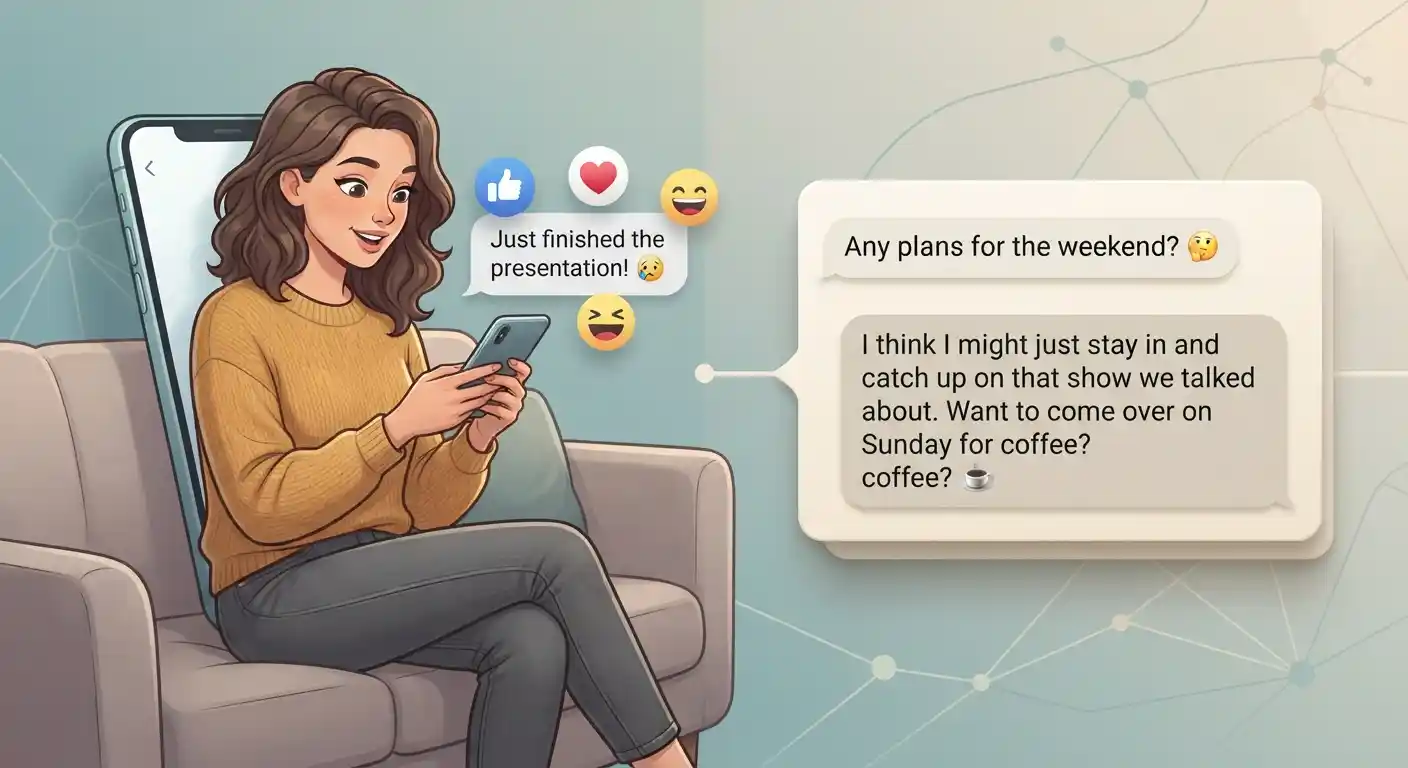
Reactions & Responses refers to the ways people react to and reply to messages, posts, comments, or other communication online. Reactions often show an immediate feeling, while responses usually involve a written or spoken reply.
Key Takeaways
- Reactions usually express a quick emotion or acknowledgment.
- Responses usually involve replying with words or a message.
- The phrase “Reactions & Responses” is not a texting abbreviation or acronym.
- Meaning can change depending on the conversation, platform, and tone.
- Emojis, reaction buttons, GIFs, and short replies can all communicate a response.
- A reaction alone does not always explain exactly what someone thinks or feels.
Reactions & Responses Meaning in Text
In texting and online communication, reactions and responses describe two common ways people interact with a message or post.
A reaction is often a quick signal. For example, someone might react to a message with a thumbs-up, heart, laughing emoji, or another reaction icon.
A response is usually a direct reply. It may be a short message, a detailed answer, a comment, or another form of communication.
For example:
- Reaction: 👍
- Response: “Sounds good to me!”
The phrase itself is not traditional text slang. Instead, it is a general communication term used when discussing how people respond to something online, in messages, or on social media.
What Does Reactions & Responses Stand For?
Reactions & Responses does not stand for anything.
It is not an acronym or texting abbreviation with a hidden full form. The phrase combines two related communication concepts:
- Reactions: Immediate expressions of emotion, opinion, or acknowledgment.
- Responses: Direct replies or answers to something someone said or shared.
The two words are often grouped together because both describe how people engage with messages and content.
How Are Reactions & Responses Used?
Reactions and responses can appear in many types of online communication.

In Text Messages
A reaction may be attached directly to a message, while a response involves sending a new message.
Example:
Alex: “I got the tickets!”
Jordan reacts: ❤️
Jordan responds: “That’s awesome! I’m excited.”
Both actions show engagement, but the written response provides more detail.
In DMs
Direct messages often include quick emoji reactions and longer replies.
Someone may react with 😂 to show they found something funny, then send a message explaining why.
In Group Chats
Reactions can help people acknowledge a message without filling the chat with repeated replies.
For example, several people might react with 👍 to show they agree with a plan.
On Social Media
Social media platforms commonly allow users to react to posts and leave comments.
A reaction may show a general feeling, while a comment gives the person a chance to explain their thoughts.
In Online Communities
People can react and respond to posts, questions, announcements, videos, and conversations.
The exact meaning depends on the platform and the type of interaction available.
Reactions & Responses in Different Contexts
The meaning behind a reaction or response can depend heavily on context.
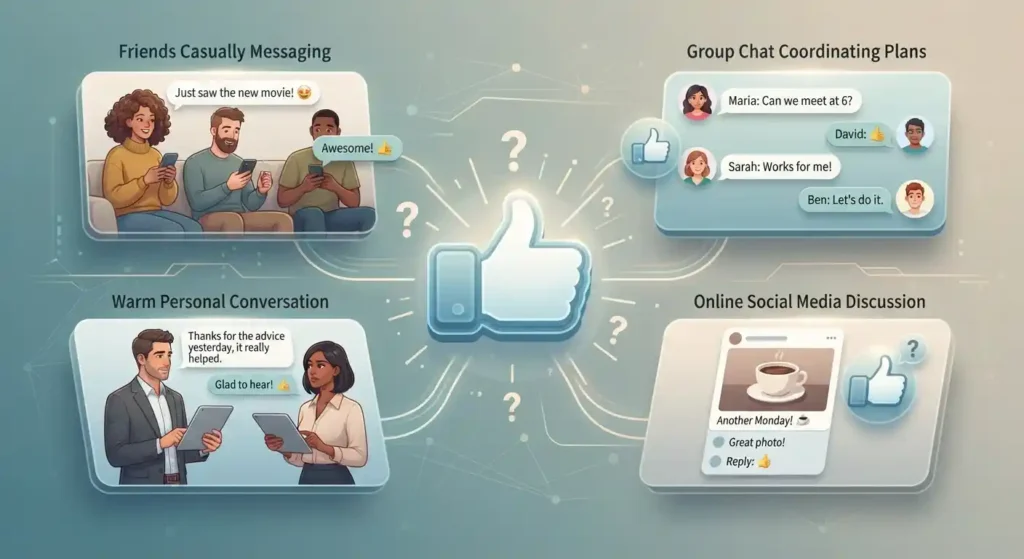
From a Friend
A friend’s reaction may simply show that they saw your message or agree with what you said.
For example, a 👍 reaction might mean “Okay,” “Got it,” or “Sounds good.”
In a Group Chat
Quick reactions are often used for convenience. Several people may react to one message instead of sending identical replies.
A heart reaction might show appreciation, while a laughing reaction may show that the message was funny.
In Dating or Relationships
Reactions and responses can carry more meaning when people know each other well, but they still depend on context.
A heart emoji or affectionate reply may show warmth, but one reaction by itself does not prove romantic interest or feelings.
In Social Media Comments
A reaction can be brief and immediate, while a written response may add an opinion, question, joke, or explanation.
Why Context Matters
When interpreting reactions and responses, consider:
- The previous conversation
- The wording of the message
- Emojis or punctuation
- The relationship between the people
- The topic being discussed
- The platform being used
The same reaction can mean different things in different situations.
Real Chat Examples
Here are realistic examples of reactions and responses in online conversations:
- Sam: “The meeting starts at 3.”
Taylor reacts: 👍 - Chris: “I finally passed my test!”
Morgan: “Congrats! That’s amazing!” - Jamie: “Look at this video 😂”
Casey reacts: 😂😂 - Alex: “Dinner at 7?”
Jordan: “Works for me.” - Riley: “I’m running a few minutes late.”
Avery reacts: 👍 - Taylor: “I got accepted!”
Sam: “No way! Congratulations!” - Chris: “That joke was terrible.”
Morgan: “I know, and I’m still laughing 😂” - Jamie: “Can everyone make it Saturday?”
Several people react: 👍 - Alex: “Thanks for helping me today.”
Jordan reacts: ❤️ - Riley: “Did you see what happened?”
Avery: “Yeah, I just saw it.” - Taylor: “I made cookies.”
Sam reacts: 😋 - Chris: “This assignment is due tomorrow.”
Morgan: “Wait, seriously?” - Jamie: “I’m thinking about changing the plan.”
Casey: “What did you have in mind?” - Alex: “That photo came out great.”
Jordan reacts: ❤️ - Riley: “I can’t believe that happened.”
Avery: “Same. I’m still surprised.” - Taylor: “Movie night?”
Sam: “I’m in!” - Chris: “Here are the details.”
Morgan reacts: 👍 - Jamie: “That was a close game.”
Casey: “Way closer than I expected.” - Alex: “Sorry for the late reply.”
Jordan: “No worries!” - Riley: “Should we try the new place?”
Avery reacts: 👀
Avery: “I’m curious about it.”
These examples show that reactions are often quick, while responses usually provide clearer information.
How to Reply to Reactions & Responses
There is no single reply to “reactions and responses” because it describes a type of communication rather than one specific message. However, you can respond naturally based on what the other person sends.
Casual Replies
- “Haha, right?”
- “Exactly.”
- “I thought you’d like that.”
- “Glad you saw it.”
- “Sounds good!”
Friendly Replies
- “Thanks for responding!”
- “I appreciate it.”
- “Glad you agree.”
- “That made me smile.”
- “Thanks for letting me know.”
Funny Replies
- “The reaction says it all 😂”
- “No words needed, apparently.”
- “I’ll take that as a yes.”
- “That emoji told me everything I needed to know.”
Neutral Replies
- “Got it.”
- “Okay, thanks.”
- “That makes sense.”
- “Thanks for the update.”
- “I understand.”
Your best reply depends on whether the other person’s reaction needs an answer. A simple emoji reaction does not always require a follow-up.
What Tone Do Reactions & Responses Have?
The phrase “Reactions & Responses” itself is neutral and descriptive.
However, individual reactions and responses can have many different tones, including:
- Casual
- Friendly
- Playful
- Supportive
- Funny
- Neutral
- Sarcastic
- Direct
For example, 😂 usually suggests amusement, while 👍 often signals agreement or acknowledgment. Still, context matters because people may use the same emoji differently.
Are Reactions & Responses Rude or Offensive?
No. The phrase “Reactions & Responses” is not rude or offensive.
Whether an individual reaction or response is appropriate depends on the situation.
Casual Conversations
Emoji reactions and short responses are common and usually appropriate.
Friends and Social Media
Quick reactions, GIFs, emojis, and informal replies are generally normal.
School or Work
A reaction such as 👍 may be acceptable for a simple acknowledgment, depending on the platform and workplace culture. More detailed responses may be better when clarity is important.
Professional Communication
Written responses are usually more useful than relying only on reaction icons, especially when confirming decisions or discussing important information.
Formal Writing
The phrase may be used in discussions about communication, feedback, or audience engagement, but casual emoji reactions are generally not part of formal writing.
Common Mistakes About Reactions & Responses
Assuming Reactions and Responses Mean the Same Thing
They are related but not identical. A reaction is often quicker and less detailed, while a response usually communicates a direct reply.
Overthinking One Emoji
A single emoji or reaction does not always reveal someone’s full opinion or feelings. Context is important.
Assuming Every Reaction Requires a Reply
Many reactions simply acknowledge a message. You do not always need to respond to them.
Ignoring Platform Differences
Different apps offer different reaction options, and users may interpret icons differently depending on the platform and conversation.
Reading Too Much Into Relationship Context
A heart, smile, or other positive reaction can have different meanings depending on the people and the conversation. It should not automatically be treated as proof of romantic interest.
Reactions & Responses and Related Terms
| Term | Meaning | Common Use |
|---|---|---|
| Emoji reaction | A visual response using an emoji or reaction icon | Texts, DMs, social media |
| Reply | A direct answer to a message or comment | Texts, chats, comments |
| Comment | A written response to posted content | Social media and online communities |
| Response | A reply or reaction to communication | Messages, conversations, feedback |
| Engagement | Interaction with content or communication | Social media and online platforms |
| Acknowledgment | Showing that a message was seen or understood | Work chats, group chats, texts |
People Also Ask About Reactions & Responses
What is the difference between a reaction and a response?
A reaction is often a quick expression of emotion, agreement, or acknowledgment. A response usually gives a direct reply using words or a more detailed message.
Does reacting to a message count as replying?
Sometimes. A reaction can show that you saw or acknowledged a message, but it may not answer a question or provide enough information for the conversation.
What does it mean when someone only reacts to your message?
It usually means they wanted to acknowledge or respond to the message quickly. The exact meaning depends on the reaction used and the conversation.
Should you respond after someone reacts to your message?
Not always. If the reaction clearly acknowledges the message and no further discussion is needed, you may not need to reply.
What is the difference between reacting and commenting?
A reaction is usually a quick icon or emoji-based interaction. A comment is a written response that can provide more detail, opinion, or context.
Can emojis be considered responses?
Yes. An emoji can function as a response when it clearly communicates a reaction, feeling, or acknowledgment.
Why are reactions useful in group chats?
Reactions let people respond quickly without sending many repetitive messages. They can make it easier to show agreement, acknowledgment, or emotion.
Conclusion
Reactions & Responses refers to the different ways people interact with messages and online content. A reaction is often a quick signal, such as an emoji or reaction icon, while a response usually involves a direct reply. The phrase is not an acronym, and its meaning is generally neutral.
The best way to understand a reaction or response is to consider the conversation, wording, relationship, platform, and overall context. Quick reactions can be useful, but a written response often provides more clarity.

Michael Anderson is a writer focused on captions and quotes designed for different moments, moods, and social settings. Over three and a half years, he has created collections covering travel, lifestyle, relationships, events, social media, entertainment, and aesthetic themes. Michael studies tone, context, and phrasing to craft captions that match specific occasions and visual styles.